Showing posts with label VAM. Show all posts

Friday, August 08, 2014

Schools Matter: Odds and Ends, first week of August 2014

First published on LA Schools Matter on August 05, 2014


The main difference between the Gates Foundation funded Common Core and Dr. Maria Montessori's method is this: Montessori did not create educational theories and then try them out on children. She did the opposite. — Jeffrey Katz

It's been a very busy summer. Here in Los Angeles we're faced with a Los Angeles Unified School District (LAUSD) school board special election to replace my dear friend, the late Marguerite Poindexter LaMotte. I've been super busy working on the campaign to elect Dr. George McKenna, working on projects around the house, and preparing for my first semester of law school — which starts in a couple of weeks. The LAUSD race is critical, the billionaires have spent millions and brought in Michelle Rhee to support neoliberal corporate reform candidate Alex Johnson.

Feedback on SAS VAM piece

Got a great email from a reader on the Value-Added Modeling (VAM) is pseudoscience, but profitable pseudosciences persist piece. They asked to remain anonymous:

Dear Mr. Skeels,

I enjoyed your post on VAM and SAS. You might want to refute this bogus claim from SAS you quoted:

Another way to see this is that the most important factor of "current" test scores is prior tests scores and, once enough prior test scores are included in the model, the socioeconomic/demographic factors become relatively small or even non-significant, despite enormous sample sizes.

Bruce Baker does a good job of debunking this claim. I've found the same is true for [REDACTED] version of EVAAS.

ed®eformers confused as to why there aren't more teachers

Paul Bruno is a big neoliberal corporate reform cheerleader. In a post trying to scold the AFT for not supporting the reactionary edTPA test initiative, he ponders why teaching should be more, or less, professional than that of fields like medicine or law. He decries things that "complicate any efforts to reduce the profession's attractiveness or to throw up additional barriers to entry" without any sense of irony.

I let Mr. Bruno know what I saw as barriers to entry:

Last spring I had to decide between pursuing a teaching credential versus attending law school. For the former, the idea of having to complete nearly the same amount of coursework as a masters degree for a job that pays considerably less was still palatable, but Common Core and Vergara made the decision easy for me.

At least as an attorney I can go after corrupt charter school chains that discriminate against special needs students.

Corporate reformers dominating university discourse

When I found out that UCLA was hosting an event featuring poverty pimps from Green Dot Charter Corporation and their spinoff Nonprofit Industrial Complex (NPIC), Parent Revolution, I was appalled.

I'm so angry my Alma Mater is allowing these poverty pimps from Green Dot Corporation and their hideous pRev spin off do a ‪#‎NPIC‬ cheer-leading event. You too can use your degree to help privatize the remainder of the public school system at the behest of Eli Broad and Bill Gates. We can do better ‪#‎UCLA‬ https://www.facebook.com/UCLAYoungAlumni/posts/10152340023341288

I wrote on the page itself.

I'm a Life UCLA Alumni member (UCLA 2014), who has spent two decades documenting how many of these so-called nonprofits carry out the agenda of their funders. To wit, this event features two members of the school privatization project. Progressive minded Bruins might want to read this before attending the event: The Revolution Will Not Be Funded: Beyond the Non-Profit Industrial Complex

I have a prior commitment, so I won't be able to attend the event. If I could, I would pass out this FAQ on Parent Revolution, and the privately managed charter corporation they were spun off from—Green Dot.

Parent Revolution, Parent Trigger, and School Privatization FAQ by Robert D. Skeels



Share/Bookmark

Thursday, July 31, 2014

Schools Matter: Value-Added Modeling (VAM) is pseudoscience, but profitable pseudosciences persist

First published on Schools Matter on July 26, 2014


"While value-added models are intended estimate teacher effects on student achievement growth, they fail to do so in any accurate or precise way. — Professor Bruce Baker"

Back in early April I penned a piece for K12NN on The American Statistical Association's (ASA) paper on Value Added Methodologies [1]. In it I asserted that the "document provides strong support to those who oppose this wrongheaded use of statistics to make high stakes decisions effecting the lives of students, educators, and our school communities." This week I noticed a trackback to a reprint of the article. What caught my eye was the title, which seemingly was entirely out of keeping with the spirit of the ASA's stance: Advocating for a robust value-added implementation.

I read through the VAM cheerleading piece and was gobsmacked by the deliberate manipulation of the ASA document's tenor and tone. This VAM apologetic read less like a legitimate blog posting and more like a corporate press release. Without doing much more research, I typed the following comments:

This quotation from the ASA document sums up the entire issue best: "The majority of the variation in test scores is attributable to factors outside of the teacher’s control". To, as the author above has, try and frame ASA's position as supportive of VAM phrenology takes mendaciousness to breathtaking heights. Rather than considering students as empty receptacles for "knowledge" deposited by a method that can be "measured," perhaps we can start talking about students as agents in their own pedagogical experiences—something that doesn't exist in the current regime of the profitable testing-industrial-complex.

The author's response displayed the same blatant avoidance of issues as the original piece. In fact, it stated some of the long discredited claims of the VAM camp, including Professor Bruce Baker's favorite trope about how "more sophisticated" VAMs address the issues people have with VAMs.

Thanks for your comment. The ASA statement seems to discuss primary drivers of student test scores, not student growth. It is well known that there is a strong relationship between students’ achievement (or test scores) and their socioeconomic/demographic background. However, there is typically little or no relationship between students’ growth and their socioeconomic/demographic background.

Another way to see this is that the most important factor of “current” test scores is prior tests scores and, once enough prior test scores are included in the model, the socioeconomic/demographic factors become relatively small or even non-significant, despite enormous sample sizes.

That said and to your concern about considering students in the context of their own experiences, more sophisticated value-added/growth models, like EVAAS, can follow the progress of individual students over time, so that each student serves as his or her own control.

Aside from being patently wrong, the whole thing smacked of being boilerplate text written in the bowels of a corporate public relations department. That's when I decided to look into this dubious Jennifer Facciolini was and who she wrote for. I should have done that in the first place.

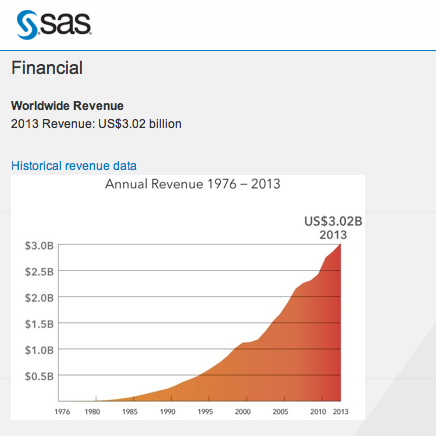
As of 2012, Statistical Analysis System (SAS) Institute Inc., is one of the largest privately owned software companies in the world with revenue $3.02 billion USD (2013). They are the developers of the wildly inaccurate, but highly profitable Education Value-Added Assessment System, (AKA SAS EVAAS) — a VAM implementation used in many districts. Money chasing SAS is all about big fish government contracts, to wit an excerpt from a recent Businessweek piece:

SAS Institute Inc. won a $6,479,583.96 federal contract from the Defense Information Systems Agency, Scott Air Force Base, Illinois, for Statistical Analysis System software licenses and support renewal.

When a huge firm like SAS pulling down big dollar defense contracts makes the education "market" their priority, you can believe that they won't let things like facts and evidence discrediting VAM get in the way of them selling and supporting their EVAAS phrenology kit to any and all districts infected by the neoliberal corporate reform virus.

Hiring several white, well educated former-teachers like Nadja Young and Jennifer Facciolini to shill for your product is a smart public relations investment for the VAM behemoth. Given that they were teachers in the south, the chances are that they are making a great deal more money at SAS by simply selling out their former profession to corporate interests. Whether the boilerplate prose in their gushing blog posts is written by them or not isn't all that important. What's important is the appearance that professional teachers actually might think that phrenology and VAM are legitimate sciences. I can only hope that that the prose in these mindless corporate posts isn't written by these former teachers. Students should never be exposed to such nonsensical drivel. A selection of some of their titles should serve to numb the mind of any sentient being:

  • Data-driven education books make great holiday gifts for educators. Yes, really.
  • "March madness" of student course enrollment gets assist from value-added assessment
  • Beyond value-added: Teachers need diagnostic data to improve their practice
  • Student growth measures can be the bridge to new assessments

I'll spare readers further torment. As the preponderance of evidence against VAM pseudoscience like the watershed ASA paper grows, expect profit hungry firms like SAS to keep doubling down on the duplicity and deception. Having an army of former teachers shilling for your defective product is a small expense compared to losing those highly profitable contracts with districts.


NOTES

[1] In its various permutations we've seen the "M" in VAM stand for Modeling, Measures, Methodologies, and others. The only honest word for last member of the acronym would be "Mendaciousness," since phrenology by any other name is…


Share/Bookmark

Wednesday, April 09, 2014

K12NN: American Statistical Association has just released a very important document on Value Added Methodologies

First published April 9, 2014 on K-12 News Network


"The President of the United States and his Secretary of Education are violating one of the most fundamental principles concerning test use: Tests should be used only for the purpose for which they were developed. If they are to be used for some other purpose, then careful attention must be paid to whether or not this purpose is appropriate" — Gerald Bracey, PhD

VAM/AGT and other neoliberal corporate reforms have all scientific validity of phrenology. They’re just as racist as well. The American Statistical Association (ASA) released their ASA Statement on Using Value-Added Models for Educational Assessment today. While their spokesperson explicitly said they neither support, nor oppose the use of so-called "Value Added" methodologies, the actual document provides strong support to those who oppose this wrongheaded use of statistics to make high stakes decisions effecting the lives of students, educators, and our school communities. Too bad the amateur statisticians at the Los Angeles Times were able to commit their egregious acts several years ago before this document was released. It's also too bad that LAUSD recently implemented one of these seriously flawed models, one that will abjectly harm students' education and further undermine the morale of our professional educators for years to come.

Some important excerpts from the document (all emphasis mine):

Estimates from VAMs should always be accompanied by measures of precision and a discussion of the assumptions and possible limitations of the model. These limitations are particularly relevant if VAMs are used for high-stakes purposes. (1)

VAMs should be viewed within the context of quality improvement, which distinguishes aspects of quality that can be attributed to the system from those that can be attributed to individual teachers, teacher preparation programs, or schools. Most VAM studies find that teachers account for about 1% to 14% of the variability in test scores, and that the majority of opportunities for quality improvement are found in the system-level conditions. Ranking teachers by their VAM scores can have unintended consequences that reduce quality. (2)

In practice, no test meets this stringent standard, and it needs to be recognized that, at best, most VAMs predict only performance on the test and not necessarily long-range learning outcomes. Other student outcomes are predicted only to the extent that they are correlated with test scores. A teacher’s efforts to encourage students’ creativity or help colleagues improve their instruction, for example, are not explicitly recognized in VAMs. (4)

Attaching too much importance to a single item of quantitative information is counter-productive—in fact, it can be detrimental to the goal of improving quality. In particular, making changes in response to aspects of quantitative information that are actually random variation can increase the overall variability of the system. (5)

The quality of education is not one event but a system of many interacting components. (6)

A decision to use VAMs for teacher evaluations might change the way the tests are viewed and lead to changes in the school environment. For example, more classroom time might be spent on test preparation and on specific content from the test at the exclusion of content that may lead to better long-term learning gains or motivation for students. (6)

Overreliance on VAM scores may foster a competitive environment, discouraging collaboration  and efforts to improve the educational system as a whole. (6)

The majority of the variation in test scores is attributable to factors outside of the teacher’s control such as student and family background, poverty, curriculum, and unmeasured influences. (7)

The VAM scores themselves have large standard errors, even when calculated using several years of data. These large standard errors make rankings unstable, even under the best scenarios for modeling. (7)

A VAM score may provide teachers and administrators with information on their students’ performance and identify areas where improvement is needed, but it does not provide information on how to improve the teaching (7)

All in all, the document is an academic condemnation of the VAM/AGT pseudosciences that have been ushered in by neoliberal corporate education reform project. While the ASA is populated with actual scientists and statisticians, we can be sure that the corporate reform crowd will be quick to try to refute the document. Here the tag-line of a recent article in Salon by Paul Rosenberg is apropos: 'Like global warming deniers, "education reformers" have nothing to  lose and everything to gain by sowing confusion'.

For a copy of the ASA Statement on Using Value-Added Models for Educational Assessment see http://www.amstat.org/policy/pdfs/ASA_VAM_Statement.pdf. For additional information, please visit the ASA website at www.amstat.org.


Share/Bookmark

Monday, January 27, 2014

Putting Eli Broad's wrongheaded 'merit' beliefs into practice


Share/Bookmark

Tuesday, November 12, 2013

Gates' VAM/AGT killed at Microsoft, but LAUSD students and educators still victimized by 'value added' phrenology


Share/Bookmark

Sunday, November 25, 2012

Refocusing LAUSD on reading and learning instead of testing

First published on Robert D. Skeels for School Board on November 24, 2012.


It's difficult to explain exactly what being poor is all about, or why access to books and ideas might be as important as a free breakfast. — Walter Dean Myers

The Power of Reading by Stephen KrashenHope Is an Open Book, an op-ed piece by author Walter Dean Myers, was tweeted this morning by educator Susan Ohanian. While written in 2005, Myers' message about access to books is profound and even more urgent today with canned corporate education solutions that narrow curriculum dominating policy. Sadly, Los Angeles Unified School District (LAUSD) is run by a Superintendent who neither values books, nor libraries. This has to change, and change quickly. We need to shutdown LAUSD's testing-industrial-complex and reopen both our school and classroom libraries. Reopening libraries also means rehiring credentialed librarian-educators. We can pay for that by ditching discredited and expensive attempts to tie teacher evaluations to test scores (VAM/AGT) and use the millions of squandered dollars associated with them. Read with your children, read in front of your children, and let them choose their own reading materials. It's a proven formula for fostering authentic life-long learning.

Free Voluntary Reading (FVR) is a well researched methodology in which students are allowed to choose their own reading materials. Professor Stephen Krashen and his colleagues have found that "[r]ecreational reading or reading for pleasure is the major source of our reading competence, our vocabulary, and our ability to handle complex grammatical constructions." The Power of Reading, Second Edition: Insights from the Research is an excellent text to familiarize oneself with the concepts and research behind FVR.


Share/Bookmark

Monday, October 29, 2012

Schools Matter: How the VAM/AGT pseudoscience worm turns

First published on Schools Matter on October 29, 2012.


While value-added models are intended estimate teacher effects on student achievement growth, they fail to do so in any accurate or precise way — Dr. Bruce D. Baker

VAM and AGT are discredited and harmful to public educationMaybe it's karma, but Kyle Hunsberger of the Gates Foundation backed astroturf TeachPlus, and one of Los Angeles Unified School District's biggest cheerleaders of the highly discredited VAM/AGT pseudosciences, is now a victim of that selfsame modern phrenology.

This quote is pretty amazing coming from a bona fides member of the "no excuses" camp.

"I have to be reassured that I don't have to lobby for honors students," Hunsberger said. "I have to know that I have a shot at a good evaluation if I teach lower-performing kids."

Maybe he'll be a former member of that camp from here out, now that he's experienced the practical application of his faulty theoretical framework. That framework incorrectly posits that "effective" teaching "overcomes" any other factor including poverty, student motivation, or even English Language Learner status.

Call me cynical, but I doubt Michael Stryer and James Encinas, Hunsberger's TeachPlus coauthors of this fact-free Op-Ed shilling for value added measures will stand by him now that the worm has turned. Corporate reformers are just like that, they're snakes and most venomous to anyone who break ranks and start telling the truth.

Let's stop testing children and start teaching them. Standardized tests are a perversion. NCLB/RTTT/CCSS are the real "status quo" and an abject failure at that.


Share/Bookmark

Tuesday, June 12, 2012

Schools Matter: Evaluate This! Shows the way forward for authentic education reform

"I am heading for a four-year college. The classes that most helped me prepare for this were NOT test prep classes. They were the ones where I got to explore stuff and do projects." — Tiffany Tuggle (CEJ Member and Senior at UCLA Community School)

Esperanza Elementary School first grade garden project at Evaluate This!I finally got around to my write up on an important PEAC/CEJ/UTLA's event in a Schools Matter piece entitled: Evaluate This! Shows the way forward for authentic education reform

Evaluate This!, was an education fair showcasing projects at various schools sites throughout LAUSD. With an emphasis on project based learning, the fair featured some absolutely amazing forms of pedagogy. Even though I arrived to catch the very end of the event, it exceeded expectations in every possible way. Even the virulently anti-public education Los Angeles Times ran a blog piece on it.

Published 2012-06-11 on Schools Matter, please read it there and share widely.


Share/Bookmark

Friday, August 19, 2011

Professor Daniel Willingham on Merit Pay, Teacher Pay, and Value Added Measures

The private sector rewards only true merit - not! — Caroline Grannan (Journalist, Editor, Educator)


[click here if you can't view this video]

Share/Bookmark